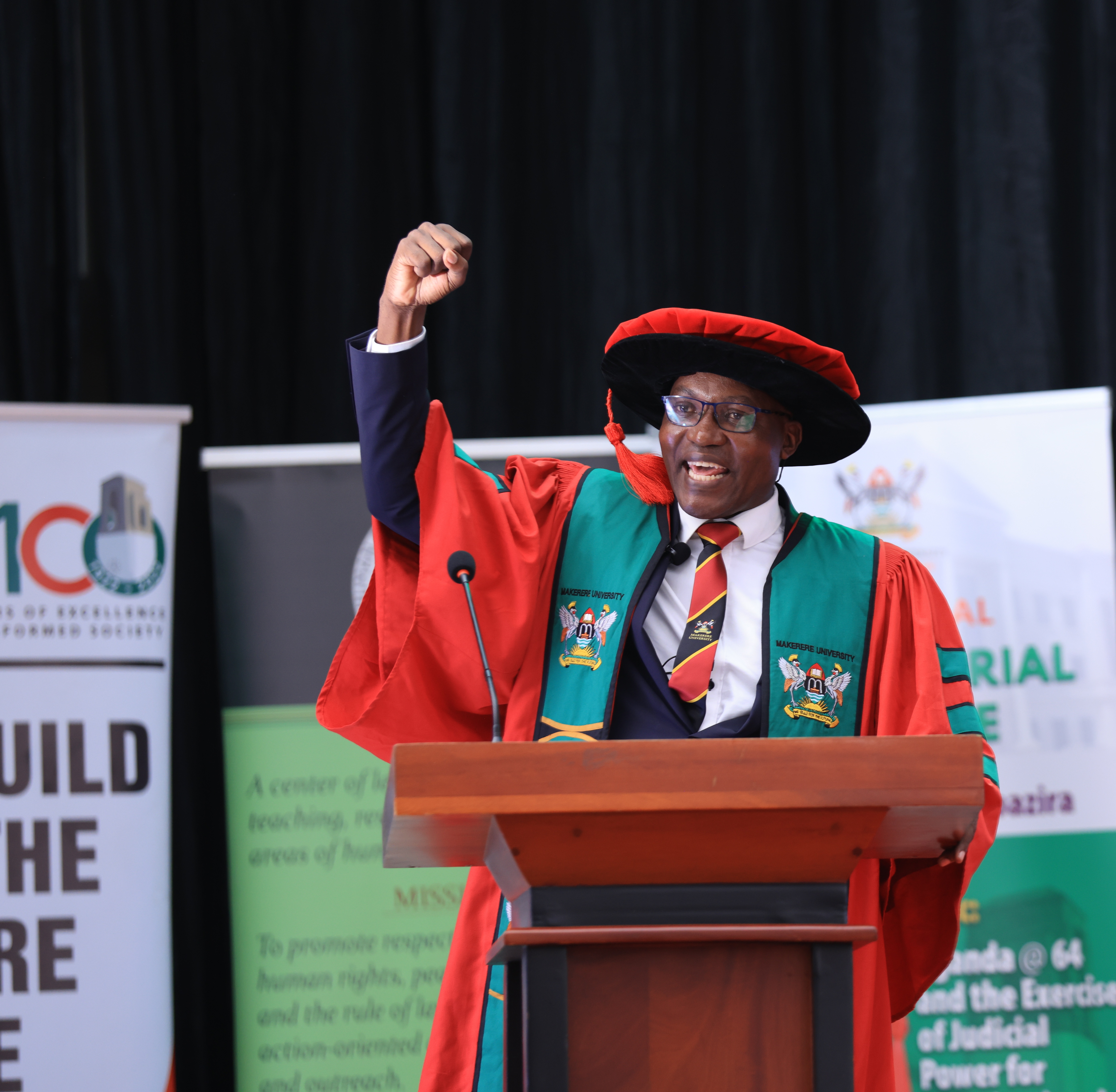
Prof. Christopher Mbazira Professorial Lecture: Examination of Uganda’s Judicial Power and Its Role in Constitutional Transformation
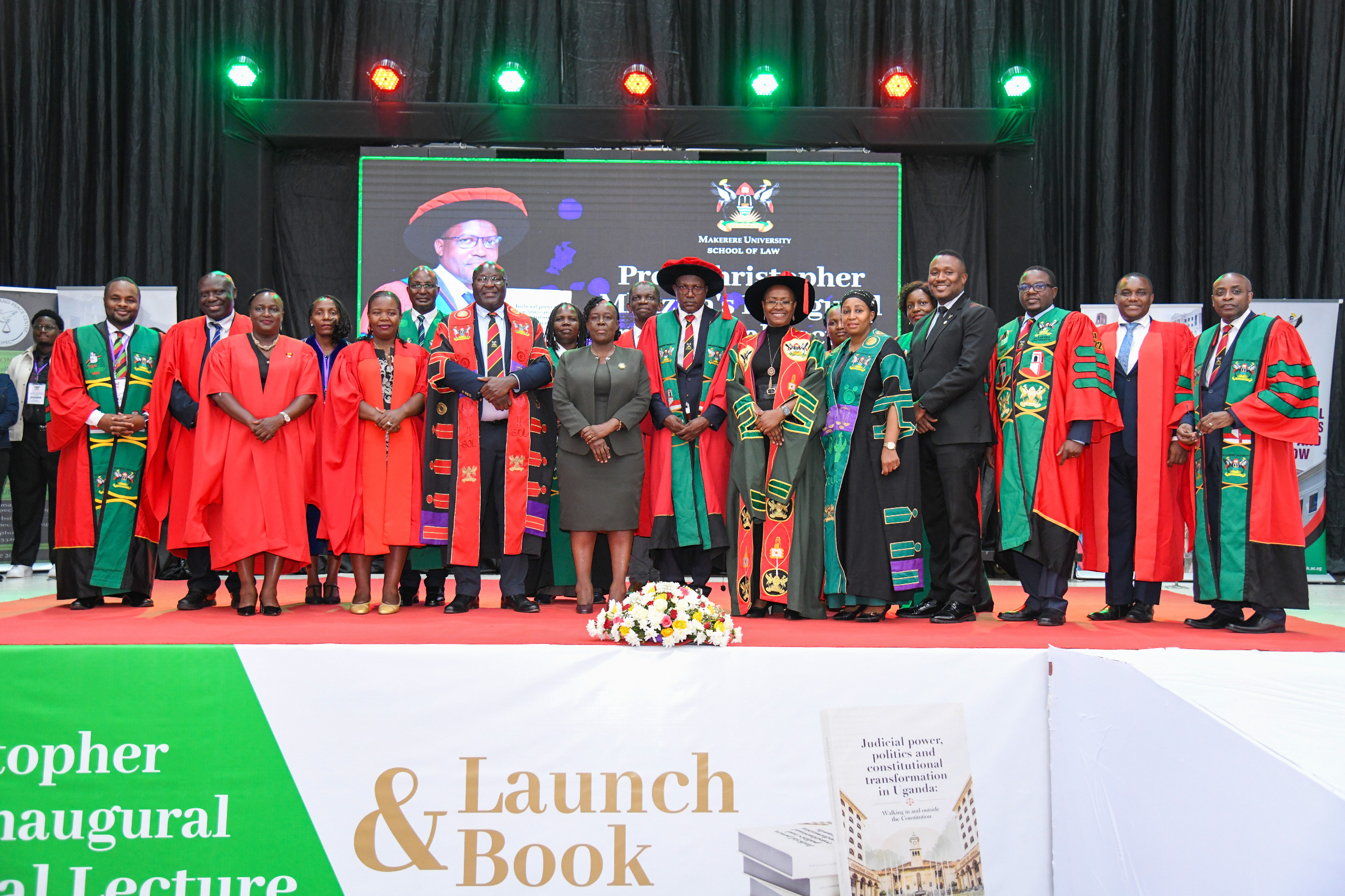
On 12th November 2026, Makerere University School of Law (SoL) hosted the Inaugural Professorial Lecture of Prof. Christopher Mbazira, who examined the role of judicial power in Uganda’s constitutional transformation over the 64 years since independence. The lecture, titled Uganda @64 and the Exercise of Judicial Power for Constitutional Transformation: Examining the Gains and Lost Opportunities, was accompanied by the launch of his book, Judicial Power, Politics and Constitutional Transformation in Uganda: Walking in and Outside the Constitution. The lecture was attended by the University Community, distinguished guests, Judicial Officers, members of the legal fraternity, students, alumni, , and the general public.
In his lecture, Prof. Mbazira critically examined the Judiciary’s contribution to Uganda’s constitutional development, highlighting its achievements, institutional resilience and missed opportunities. He traced the evolution of judicial power from the colonial period and the early post-independence constitutional crises to the current constitutional dispensation under the 1995 Constitution.
Reflecting on some of the defining moments in Uganda’s history, he examined how the Judiciary’s exercise of power has shifted in response to changing political circumstances. He traced this history through the Amin regime, during which Chief Justice Benedicto Kiwanuka was abducted, to the National Resistance Movement (NRM) era, which he characterised as hybrid—democratic in form but authoritarian in instinct.
A central question in his lecture was whether Ugandan courts possess the power to influence constitutional transformation and, more importantly, when they choose to exercise that power or retreat from it. He argued that courts are not merely neutral referees but political actors whose decisions shape the country’s constitutional trajectory. In his assessment, the Judiciary’s record has been marked by inconsistency, reflecting the broader complexities of Uganda’s constitutional journey.
Drawing on landmark judicial decisions, Prof. Mbazira illustrated this inconsistency through instances in which courts have defended fundamental freedoms, including habeas corpus, and struck down restrictive laws on public assembly, as demonstrated in the Muwanga Kivumbi and Human Rights Network Uganda cases. However, he observed that courts have sometimes been less assertive when judicial decisions directly challenge the exercise of political power. He traced this pattern to the early post-independence period, referencing the Ibingira and Ex parte Matovu cases, in which courts affirmed aspects of individual liberty but declined to determine the legality of the new political order following the abrogation of the 1962 Constitution.
The lecture further explored the relationship between judicial power, politics and constitutionalism, highlighting the Judiciary’s responsibility to safeguard fundamental rights, check the exercise of public power and advance democratic governance. Prof. Mbazira acknowledged the Judiciary’s contributions to gender equality, freedom of expression and assembly, and the protection of fundamental rights. At the same time, he examined persistent challenges, including political interference, court-curbing and threats to judicial independence.
He emphasised that sustainable constitutional transformation requires an independent, principled and responsive Judiciary, supported by respect for constitutional supremacy and judicial authority. He called for timely adjudication of cases, effective constitutional remedies, compliance with court decisions and stronger safeguards for democratic institutions.
The lecture provided an important opportunity to reflect on Uganda’s constitutional journey and the continuing responsibility of the Judiciary in strengthening democracy, constitutionalism and the rule of law.
School of Law Celebrates a Milestone in Legal Scholarship
The Chairperson of the Organising Committee, Dr. Rose Nakayi, described the event as a significant milestone for the SoL, noting that it was the first inaugural professorial lecture organised under Makerere University’s new guidelines, which decentralised the organisation of such lectures to academic units.
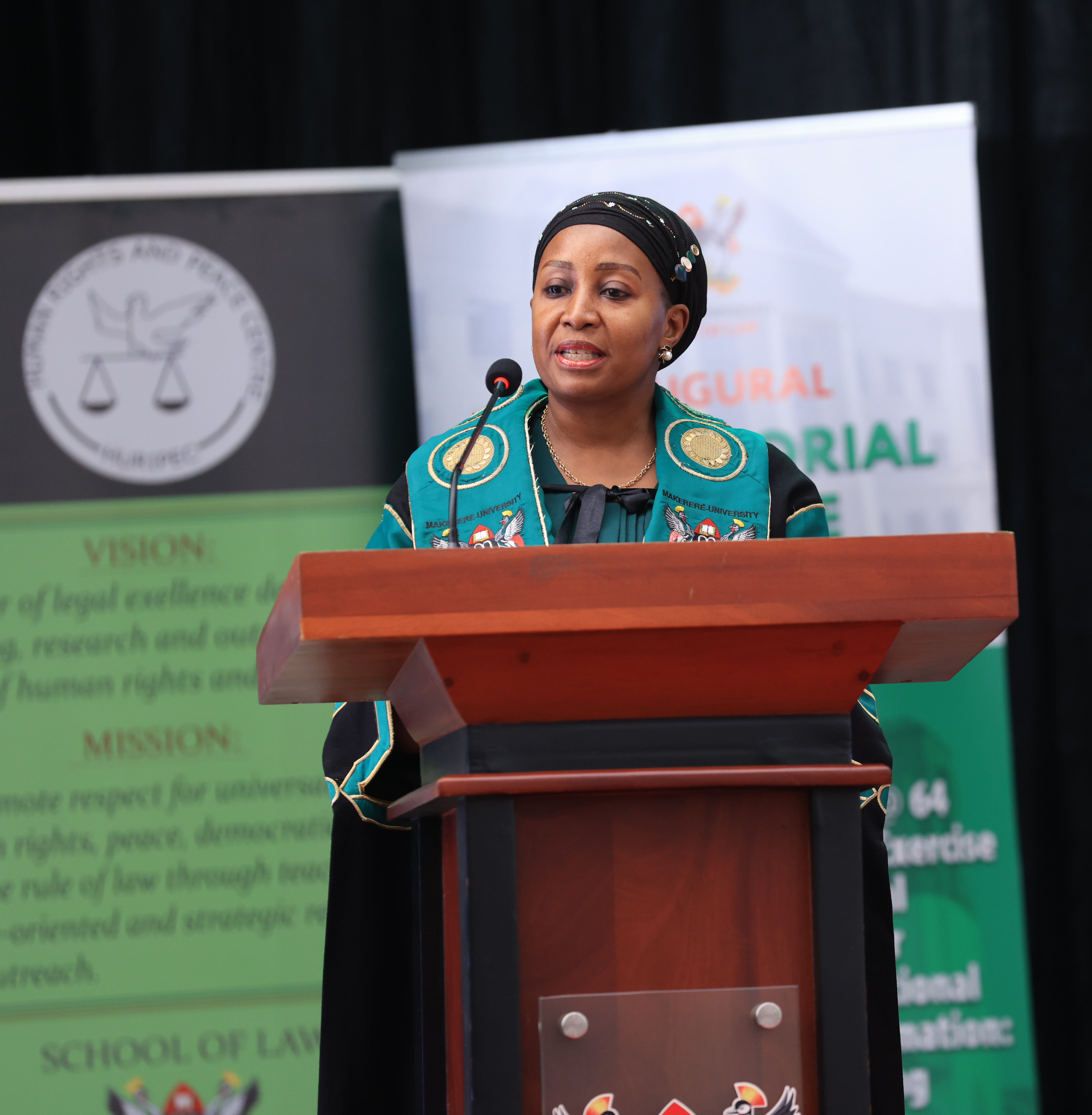
She also highlighted the significance of the occasion coinciding with the launch of Prof. Mbazira’s book, which was developed during his sabbatical.
Reflecting on their longstanding friendship and shared academic journey, Dr. Nakayi celebrated Prof. Mbazira’s growth from a law student into a distinguished legal scholar. She acknowledged the influence of senior academics who had mentored and inspired them, while appreciating the organising committee, University Management, supporting units, staff and students for their contributions to the success of the event.
Congratulating Prof. Mbazira on the achievement, she observed that the professorial milestone was not the culmination of his academic journey but the beginning of another chapter in his professional and scholarly contribution.
University Management Commends Prof. Mbazira’s Contribution to Legal Scholarship
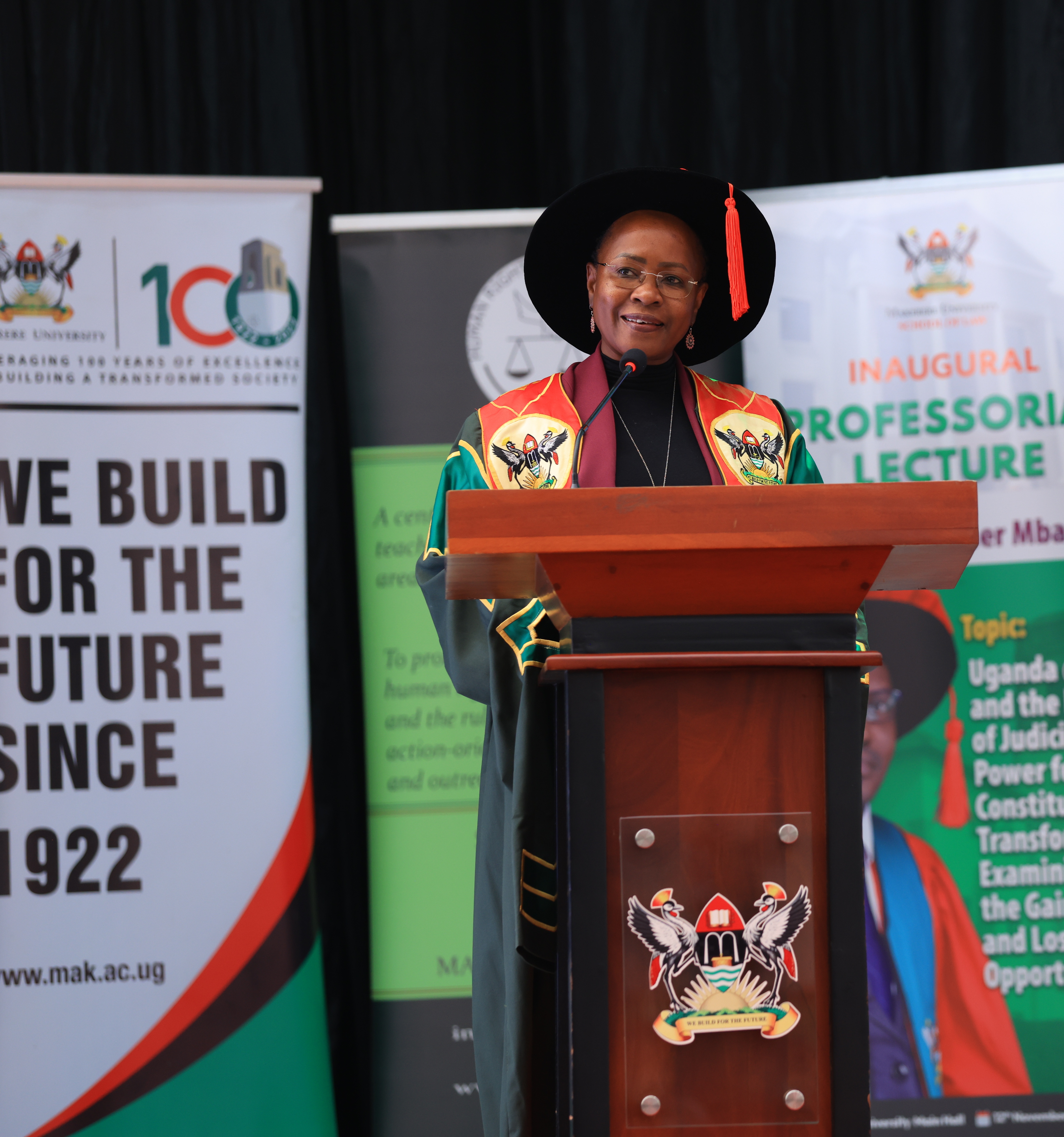
In remarks delivered on his behalf by the Deputy Vice Chancellor for Academic Affairs, Prof. Sarah Ssali, the Vice Chancellor, Prof. Barnabas Nawangwe, congratulated Prof. Mbazira on attaining the professorial rank, describing the achievement as a source of pride for Makerere University and a reflection of the University’s commitment to intellectual excellence.
He commended Prof. Mbazira’s contributions to constitutional law, judicial power, human rights and the administration of justice through research, teaching, mentorship and public interest lawyering. He noted that his scholarship continues to inform national conversations on constitutionalism, democratic governance, accountability and the rule of law.
The Vice Chancellor also encouraged other professors to deliver their inaugural professorial lectures, describing them as important platforms for showcasing research, inspiring emerging academics and sharing knowledge with the wider society.
The Acting Dean of the School of Law, Dr. Zahara Nampewo, also congratulated Prof. Mbazira, describing his professorial achievement as an important milestone for both the scholar and the School. She commended his contributions to legal scholarship, particularly in constitutional law, human rights and the administration of justice, as well as his dedication to teaching, research and mentorship.
Dr. Nampewo noted that the inaugural lecture offered an important platform for examining the Judiciary’s role in Uganda’s constitutional development and reflecting on the continued pursuit of justice, democratic governance and the rule of law.
Prof. Mbazira’s Book Launched
The book, Judicial Power, Politics and Constitutional Transformation in Uganda: Walking in and Outside the Constitution, was officially launched by Hon. Lady Justice Prof. Lilian Tibatemwa-Ekirikubinza, Justice of the Uganda Court of Appeal.
Congratulating Prof. Mbazira on the publication, Justice Tibatemwa-Ekirikubinza expressed pride in witnessing his academic growth and development over the years, describing the book as a testament to his scholarly journey.
Makerere Reaffirms Commitment to Transformative Scholarship
In her vote of thanks, Prof. Sarah Ssali congratulated Prof. Mbazira on his inaugural professorial lecture and the launch of his book. She commended his contribution to legal scholarship, noting that the lecture had stimulated important reflections on the Judiciary, constitutional governance and Uganda’s democratic development since independence.
Prof. Ssali reaffirmed Makerere University’s commitment to promoting impactful research, intellectual leadership and scholarship that informs policy, strengthens institutions and contributes to societal transformation. She also appreciated the School of Law, University Management, organising committee, invited guests, staff, students, family and friends for their support in making the occasion a success.
She concluded by encouraging scholars to pursue research that challenges conventional thinking, informs public policy and makes a meaningful contribution to society, reiterating the University’s pride in Prof. Mbazira’s contribution to its intellectual tradition.
About Professor Christopher Mbazira
Prof. Christopher Mbazira is a Professor of Law at SoL, where he has previously served as Dean and Head of the Department of Public and Comparative Law. He is currently the Coordinator of the Public Interest Law Clinic (PILAC) and a founding member of the Network of Public Interest Lawyers.
With over two decades of experience in human rights scholarship and practice, Prof. Mbazira has made significant contributions to access to justice, governance reform and institutional strengthening across the Justice, Law and Order Sector. He is a renowned practitioner in public interest litigation, a human rights advocate and a champion of the rule of law. Among his notable contributions is the revitalisation of the Amicus Curiae practice in Uganda.
In recognition of his contribution to legal education, he received the Uganda Law Society Award for Distinguished Service in Legal Education in 2021. He has also been an active member of the Uganda Law Society, serving on various committees. His academic engagements extend beyond Uganda, having served as a guest lecturer at several universities across Africa and internationally.
Prof. Mbazira is a member of the International Board of FIAN International, a Germany-based human rights organisation. His work also extends to business and human rights, through research and the provision of technical support to institutions working in this field. Combining scholarly expertise with practical legal experience, he has established himself as an influential voice in legal education, public interest law and human rights advocacy.
He is a published legal scholar, with his latest publication being Judicial Power, Politics and Constitutional Transformation in Uganda: Walking in and Outside the Constitution, published by Pretoria University Law Press in 2026.