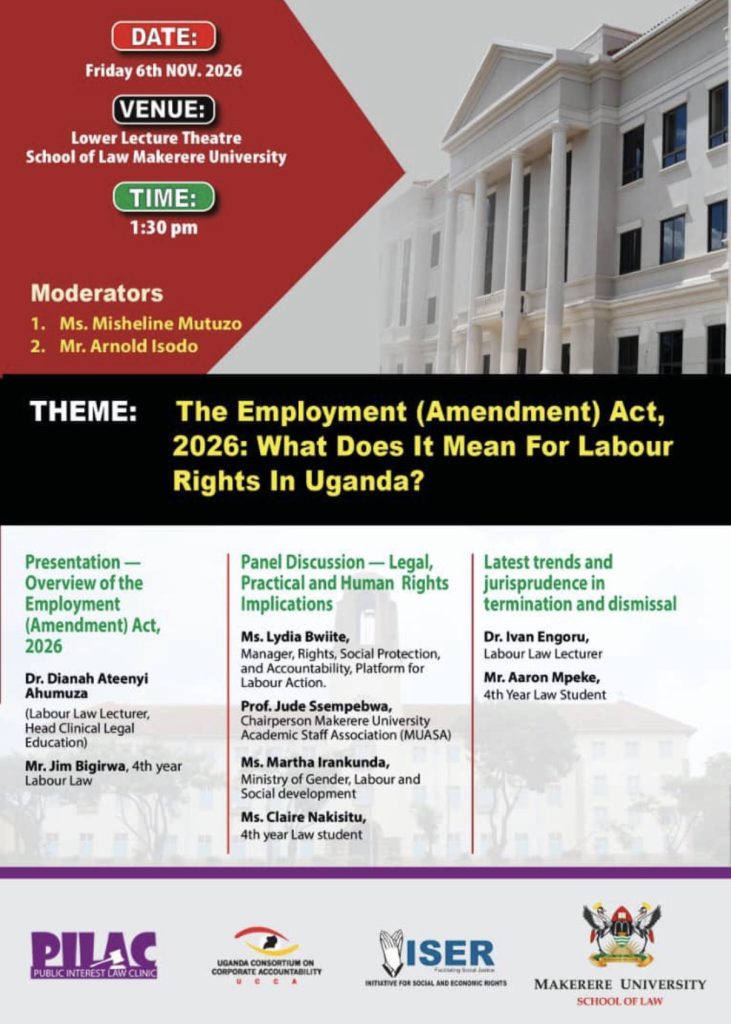
Stakeholders Examine Implications of Employment (Amendment) Act, 2026 for Labour Rights in Uganda
Makerere University School of Law (SoL), through its Public Interest Law Clinic (PILAC), in collaboration with the Initiative for Social and Economic Rights (ISER) and the Uganda Consortium on Corporate Accountability (UCCA), convened a stakeholder engagement to examine the implications of the Employment (Amendment) Act, 2026 for labour rights in Uganda.
Held on Friday, 6th November 2026, under the theme “The Employment (Amendment) Act, 2026: What Does It Mean for Labour Rights in Uganda?”, the engagement brought together legal academics, government representatives, labour rights advocates, civil society actors, legal practitioners and students to discuss the reforms and their implications for workers, employers and the wider labour market.

In his welcome remarks, Prof. Christopher Mbazira, Coordinator of the Public Interest Law Clinic (PILAC), emphasised the role of universities in connecting legal scholarship with community needs and public understanding of legislative and policy developments. He noted that legal reforms often take place without sufficient public awareness and underscored the importance of bringing together diverse stakeholders to examine their implications and promote practical understanding of the law.
Mr. Joseph Byomuhangyi, Coordinator of UCCA, described the engagement as timely, highlighting persistent labour rights concerns such as precarious employment, casualisation, limited access to social security, unclear termination procedures and restrictions on freedom of association. He called for greater collaboration among academia, civil society and government to strengthen accountability and protect vulnerable workers, including domestic workers and those in corporate supply chains.
Representing the Dean of the SoL, Dr. Ivan Engoru, Head of the Department of Commercial Law, encouraged students to use the engagement as an opportunity for practical learning. He also challenged participants to reflect on the changing nature of employment relations and the growing influence of public policy on the relationship between employers and employees. He subsequently declared the engagement open.

The programme featured a presentation on the Overview of the Employment (Amendment) Act, 2026, delivered by Dr. Dianah Ateenyi Ahumuza, Lecturer and Head of Clinical Legal Education at the School of Law, and Mr. Jim Bigirwa, a fourth-year Bachelor of Laws student. Their presentation highlighted key reforms relating to labour dispute resolution, workplace harassment, protection of vulnerable workers, sick pay, maternity support, termination and dismissal, severance pay, and the regulation of migrant workers and recruitment agencies. It also emphasised the importance of effective implementation, particularly in extending meaningful protection to workers in the informal sector.
A panel discussion featuring representatives from academia, government, civil society and the student community examined the practical and human rights implications of the amended law. Panellists included Ms. Lydia Bwiite, Manager for Rights, Social Protection and Accountability at the Platform for Labour Action; Prof. Jude Ssempebwa, Chairperson of the Makerere University Academic Staff Association (MUASA); Ms. Martha Irankunda from the Ministry of Gender, Labour and Social Development; and Ms. Claire Nakisitu, a fourth-year LLB student.
The panel discussion highlighted the need to translate the provisions of the Employment (Amendment) Act, 2026 into meaningful protection for workers, noting that the success of the reforms will depend largely on effective implementation, employer compliance and the capacity of labour institutions to enforce the law. The discussion highlighted the Act’s potential to strengthen workers’ rights and promote decent work, while noting that its impact will depend on effective enforcement, adequate resources for labour institutions, the development of implementing regulations and greater public awareness of workers’ rights and employers’ obligations.

Other issues explored included the protection of informal and migrant workers, employer compliance, job security for young workers, gender equality and the implications of new workplace arrangements such as remote and technology-driven employment. Panellists called for continued collaboration among government, employers, workers, civil society and academia, as well as research to assess the impact of the reforms and inform future labour policy.
The engagement also featured a session on Latest Trends and Jurisprudence in Termination and Dismissal, with contributions from Dr. Ivan Engoru and Mr. Aaron Mpeke, a fourth-year LLB student. They examined evolving judicial interpretations of employment law, particularly the requirement for procedural and substantive fairness in termination and dismissal. Other areas addressed included performance improvement processes, collective termination, constructive dismissal, workplace investigations, remedies for unlawful termination and the computation of severance pay. The session highlighted the importance of employers complying with legal requirements and the continuing role of judicial decisions in shaping employment relations.
In her closing remarks, the Acting Dean, Dr. Zahara Nampewo, thanked the resource persons and panellists for sharing their expertise and acknowledged the students, colleagues and other participants for their engagement.
The collaboration with ISER and UCCA further demonstrated the importance of partnerships between academic institutions and civil society in promoting social justice, accountability and the protection of rights in Uganda.
Download: Highlights-from-Discussions-at-Engagement_Labour-Law